Almost every single freshman I spoke to at Stanford this year, if asked (or sometimes not), told me they were disappointed with the quality and content of their conversations with peers. “I thought that Stanford students were supposed to be smart(er than this)” is a common refrain. So is the designation that they were having no “real” or substantive conversations, however you might define it. I imagine this means, to them, ones about politics or philosophy or some such.
Now, maybe I just surround myself with arrogant, pretentious people. Or, they sense this is something I would agree with and so preempt me. I don’t think either of these happens to be the case—the former because you, reading this, are a person I surround myself with, and the latter because I don’t surround myself with anxious sycophants who try only to be agreeable. In fact, I seem to make friends with those who do their utmost to be downright disagreeable at every turn.
To some extent, though, I agree with the sentiment. I had far fewer “substantive” conversations, whose dressings (vocabulary, grammar, gesticulation, etc.) were often less refined, than one might expect of the “greatest minds of our generation.” This troubled me for a time, but, as with anything on Stanford’s campus, such interactions can be found with a bit of elbow grease.
Fast forward to my return home, and now these conversations just drop out of the sky. “Herr, wirf Hirn vom Himmel”—our prayers have been answered.
Granted, the age demographic I interact with off-campus is significantly . . . more advanced . . . than while in the dorms, but I don’t place too much weight on age—nor, it seems, do many other young folk—as a harbinger of one’s being interesting.
But to my point: the conversations, so hard won in what ought to be a target-rich environment, were now of garden variety in, say, a less-than-prestigious walk (excuse me) through the Safeway parking lot.
Take, for example, the conversation I had with the volunteer cashier at a local nonprofit bookstore. She saw me flipping through Sven Beckert’s tome Capitalism: A Global History, and warned me that it didn’t have much of a plot. A humble start, but we then lamented that it didn’t live up to his other book, Empire of Cotton, which we both enjoyed. I asked for some related recommendations, and she suggested How to Hide an Empire, whose author she couldn’t remember. Emmerwald? Immerwahl? Daniel Immerwahr, I supplied. I’d read some of his other work. We flipped back and forth, and the conversation wandered over to Marx, quoting Lenin, and she handed me a few stapled booklets and zines I might be interested in. When I chose Baptist’s The Half Has Never Been Told for myself, she seemed shocked I hadn’t read it. I had—I just wanted my own copy of it. So, of course, we launched into discussion and traded further reading recommendations.
“Wait!” you cry, interrupting me quite rudely. “This is someone who works in a bookstore. Of course they’ll be well read!”
To which I reply, “The comparison here is with Stanford University, whose Master’s and PhD students weren’t half as capable of discussing Marx at any level of sophistication—in a sociology class that spent weeks on him, no less. I think her being a retired librarian does nothing to dilute my point.”
One might expect that I’d be ravenous for this kind of thing, talking about real things with smart people. And I was, certainly, when I was in a known environment—at the dinner table, in a bookstore, on a call with friends—but the surprise opportunities stretched me a bit too far.
While walking down from the grocery store to the bakery, a random man on the sidewalk asked me if I wanted to talk about the oppression of the Black Man by the White Man. Now, as a trained native of Oakland, I showed no sign of having heard him and walked right on. That’s what one does when somebody tries to hand you a pamphlet or sell you something or screams at you—you treat them the same as you might a lamppost (albeit with a wider radius).
But it seemed not right that my habitus reacted the same way to him as it might to a puddle—stepping around the obstacle without a break in stride—particularly when, internally, I thought to myself, “Why yes, I would be interested in hearing what you have to say about that.”
Having just read Cedric Robinson and DuBois and Patricia Hill Collins and having just had that conversation at the bookshop, I had a more than slight inclination to take up his offer. Is race a byproduct of capitalist history? Does it obscure the more fundamental issues of class, or is it a unique category neither reducible to nor extricable from it? Or maybe it is extricable from it?
So the thoughts bounced back and forth while the baker dropped a dinner roll on the way out of the oven and I paid for my loaf and considered talking to the man, having been extended the offer to “catch you on the way back,” and ultimately walked past him and did my grocery shopping and went home thinking about what he—and I—might have said.
To a large degree, that’s what I envision all the complaints about conversations at Stanford boiling down to: a bunch of fairly intelligent people walking right past one another, thinking the other guy is the potentially stupid but definitely cowardly and at best incompetent conversationalist.
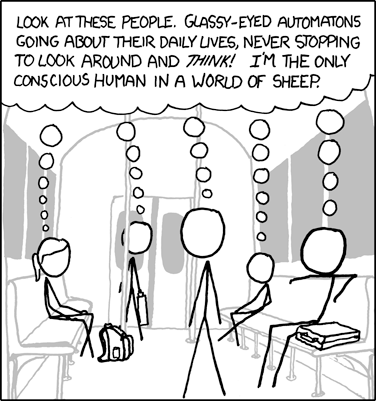
XKCD, “Sheeple”
 Quinn Cook
Leave a comment